FW15C
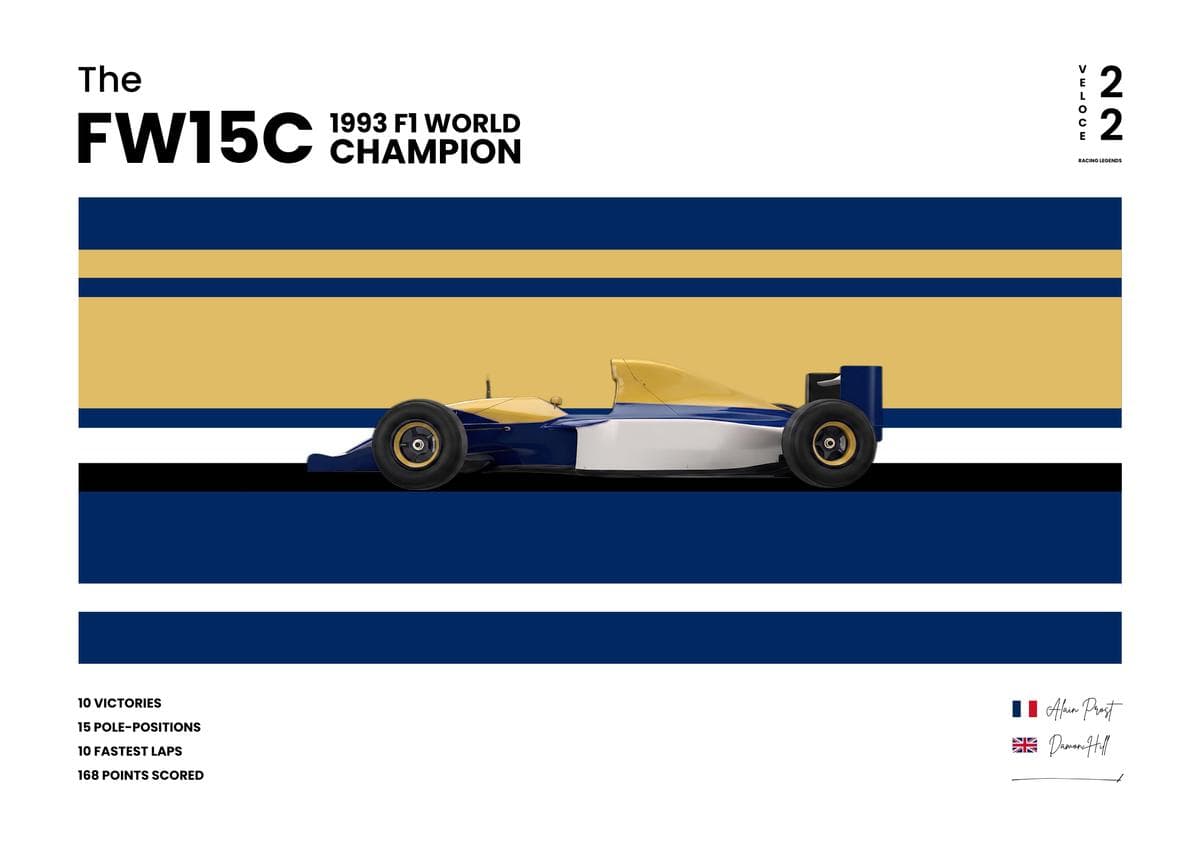
The ultimate racing computer. A technological masterpiece of Formula 1, immortalized by its crushing dominance, revolutionary active suspension, and Alain Prost’s fourth and final world championship title in 1993.
About this archive
The Williams-Renault FW15C, introduced for the 1993 season, is the most radical expression of an era driven by the dawn of onboard electronics. Designed by the genius Adrian Newey to cement the British team's supremacy over helpless rivals, this machine was conceived as a rolling laboratory, capable of dictating its law on every racetrack in the world at staggering speeds./n/nImmediately recognizable by its iconic blue, white, and yellow "Canon" livery and its absolute aerodynamic purity, the FW15C hid the greatest concentration of driver aids in motorsport history beneath its bodywork. Computer-controlled active suspension, traction control, ABS brakes, bidirectional telemetry, and even an automatic gearbox: the monoplace adapted in real time to every millimeter of asphalt. Under the cowl, the legendary 3.5-liter Renault V10 engine unleashed nearly 780 horsepower in a piercing, high-pitched scream, catapulting the car forward with surgical efficiency./n/nA true icon of modern engineering, the FW15C entered collective memory as "the most advanced Formula 1 car of all time." Its cockpit, packed with digital screens and complex switches, serves as a reminder that behind its wheel, the driver was no longer just taming raw mechanics, but dialoguing with an artificial intelligence to extract the ultimate tenth of a second./n/nFrozen in time by the abrupt ban on all electronic aids at the end of 1993, the FW15C remains the ultimate monument to an era of limitless engineering. It conquered posterity by claiming 15 pole positions out of 16 races, pushing the boundaries of physics and technology before regulations brought Formula 1 back to a more human philosophy.